Quick Answer
Glue down vinyl is bonded directly to the subfloor with adhesive and is the industry standard for commercial and high-traffic applications. Floating vinyl clicks together and sits loose over the subfloor, making it faster, less expensive, and ideal for most residential installations.
The right choice depends on your space, traffic level, and long-term plans. Below we break down every factor so you can decide with confidence.
Expert Tip: If you are flooring a commercial space in Stuart, Port St. Lucie, or anywhere on the Treasure Coast, glue down is almost always the right call. The dimensional stability and plank-replaceability alone justify the investment.
What Is Glue Down Vinyl?
Glue down luxury vinyl (sometimes called LVT or glue down LVP) is a vinyl flooring product that is adhered directly to the subfloor using a troweled adhesive. Unlike floating floors that lock together and sit loose, every plank or tile is permanently bonded to the floor beneath it.
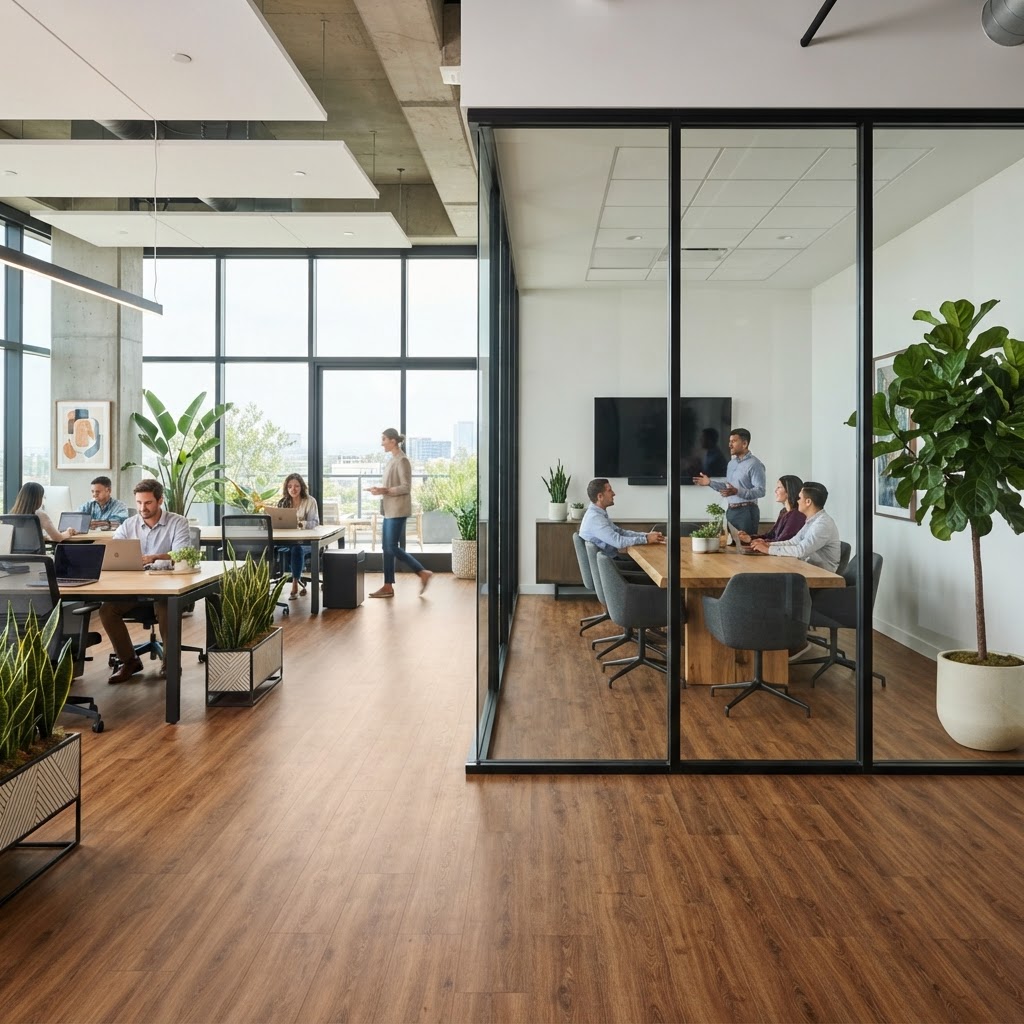
Glue down vinyl is the commercial standard because of its dimensional stability — it will not shift, gap, or buckle under heavy foot traffic, rolling carts, or temperature changes. It is the flooring of choice for offices, medical facilities, retail spaces, restaurants, and Tenant Improvement (TI) projects throughout Florida.
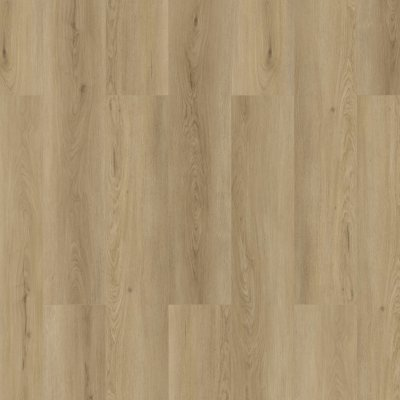
Explore our Glue Down Luxury Vinyl Collection including the SFI Bolster collection installed in commercial projects across the Treasure Coast.
Key characteristics of glue down vinyl:
- Permanently bonded to subfloor with adhesive
- Superior dimensional stability (no shifting or gapping)
- Individual planks can be cut out and replaced if damaged
- Available in planks (wood visuals) and tiles (stone/wood visuals)
- Typically 2–3mm thick with a 20–28 mil wear layer
- Requires precise subfloor preparation
What Is Floating Vinyl?
Floating luxury vinyl plank (LVP) uses a click-lock system where planks lock together along their edges. The assembled floor "floats" over the subfloor — it is not glued, nailed, or stapled down. A thin underlayment (either attached to the planks or rolled out separately) sits between the flooring and the subfloor for sound absorption and minor subfloor compensation.
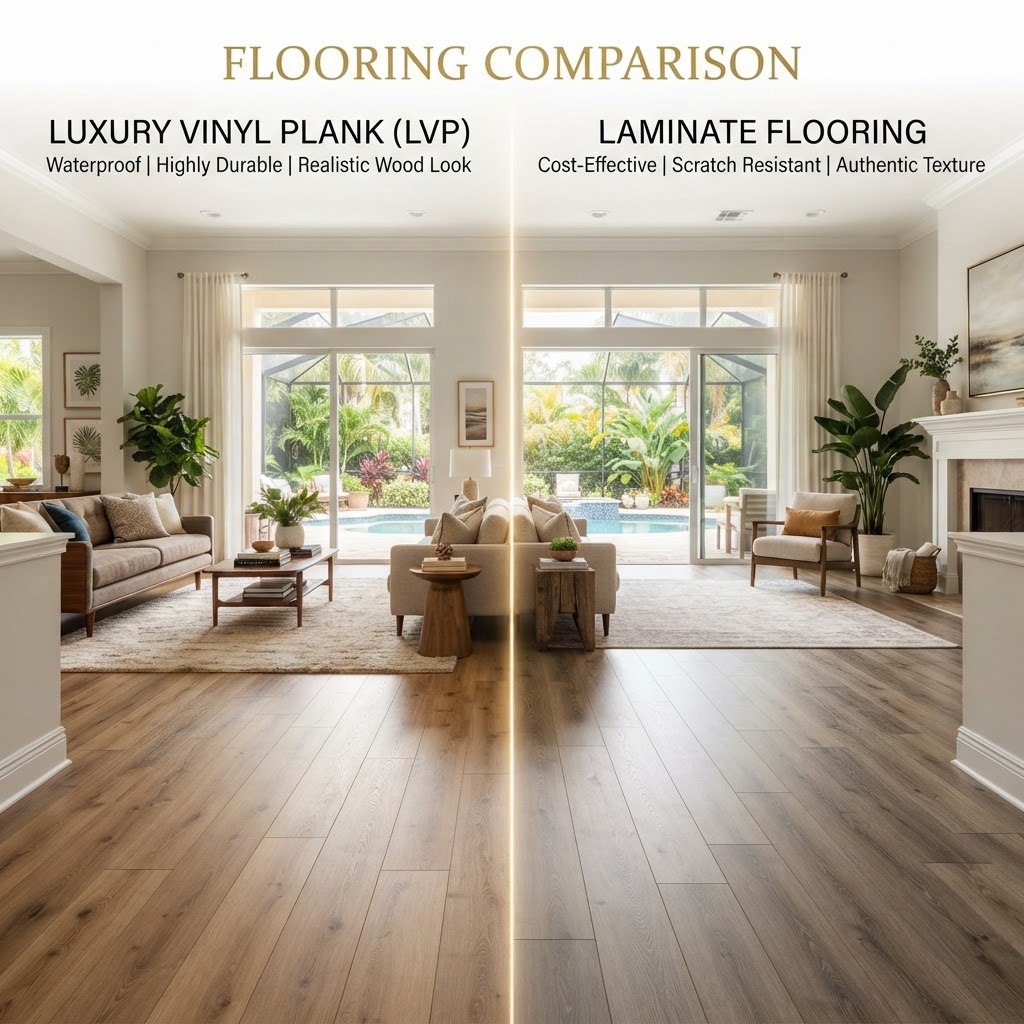
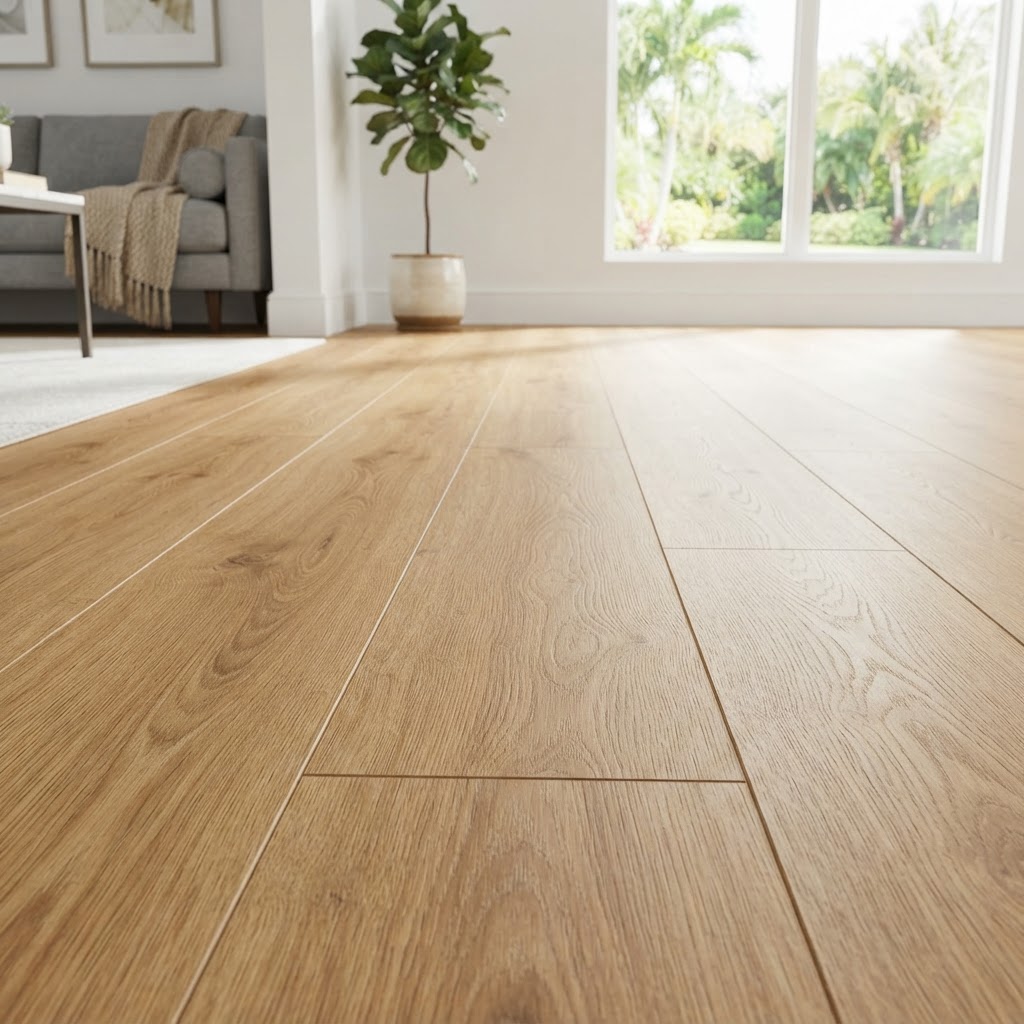
Floating LVP is the residential standard because it is faster to install, less expensive, and more tolerant of minor subfloor imperfections. Most of the luxury vinyl plank installed in Florida homes is floating.
Browse our Luxury Vinyl Plank Collection for floating LVP options installed throughout the Treasure Coast.
Key characteristics of floating vinyl:
- Click-lock edges, no adhesive required
- Floats over underlayment on top of the subfloor
- Faster and less expensive to install
- More tolerant of minor subfloor irregularities
- Typically 4–8mm thick with a 12–22 mil wear layer
- Can be installed over existing flooring in some cases
Commercial vs Residential Applications
| Factor | Glue Down | Floating |
|---|---|---|
| Commercial suitability | Excellent | Limited to light commercial |
| Residential suitability | Good (but often overkill) | Excellent |
| Heavy foot traffic | Ideal | Not recommended |
| Rolling loads (carts, equipment) | Ideal | Risk of joint stress |
| Office environments | Industry standard | Not recommended |
| Medical facilities | Industry standard | Not recommended |
| Retail spaces | Industry standard | Light retail only |
| Residential living spaces | Works well | Preferred method |
| Residential kitchens & baths | Works well | Preferred method |
The application is the single biggest driver of the decision. Here is how PTAH Flooring approaches it:
Commercial projects (offices, medical, retail, restaurants, TI projects) — We almost always recommend glue down. The dimensional stability, resistance to shifting under heavy traffic, and ability to replace individual damaged tiles make it the only sensible choice for a commercial floor that needs to last 10–20 years.
Residential projects (homes, apartments, condos) — We typically recommend floating LVP. It is faster to install, less expensive, and performs excellently in residential traffic. The waterproof construction is identical to glue down; the difference is purely the installation method.
See our detailed guide on the Best Flooring for Offices for more commercial recommendations.
Subfloor Requirements
This is where the two methods differ significantly, and it has a real impact on cost.
Glue Down Subfloor Requirements
Glue down vinyl demands a very flat, smooth, clean subfloor. Any imperfection — a crack, a bump, residual adhesive — will telegraph through the thin vinyl and may interfere with the adhesive bond. Subfloor preparation for glue down typically includes:
- Grinding or shot-blasting to remove existing adhesive and contaminants
- Crack repair and patching with a cementitious patch
- Skim coating to create a perfectly smooth surface
- Moisture testing (concrete subfloors must meet the adhesive manufacturer's moisture limits)
- Application of a primer if required by the adhesive system
This preparation is labor-intensive and is a significant portion of the total installation cost. However, it is non-negotiable for a successful glue down installation.
Floating Subfloor Requirements
Floating LVP is more forgiving of subfloor imperfections because the underlayment compensates for minor irregularities. Subfloor preparation typically includes:
- Cleaning to remove debris and dust
- Repairing major cracks, humps, or dips
- Ensuring the subfloor is within the manufacturer's flatness tolerance (usually 3/16" over 10 feet)
- Rolling out underlayment (if not attached to the planks)
Floating installation does not require the same level of surface perfection, which is why it is faster and less expensive.
Expert Tip: No matter which method you choose, PTAH Flooring includes professional subfloor preparation in every installation. Skipping floor prep is the #1 cause of flooring failures, and we never cut corners on it. Read more about our installation process and the process we follow on every project.
Durability
| Factor | Glue Down | Floating |
|---|---|---|
| Dimensional stability | Excellent | Good |
| Resistance to shifting/gapping | Excellent | Good (with proper expansion gaps) |
| Heavy traffic durability | Excellent | Moderate |
| Impact resistance | Very good | Good |
| Plank replacement | Easy (cut out and replace) | Moderate (unlock surrounding planks) |
| Lifespan (commercial) | 10–20 years | 5–10 years |
| Lifespan (residential) | 15–25+ years | 15–25 years |
Both methods use the same waterproof vinyl material, so the inherent durability of the flooring itself is similar. The difference is in how the floor performs over time under stress:
- Glue down will not shift, gap, or buckle because every plank is anchored. This is critical in commercial settings where heavy foot traffic, rolling chairs, and equipment movement would stress a floating floor over time.
- Floating floors rely on the click-lock joints and expansion gaps to accommodate movement. In residential settings, this is perfectly adequate. In commercial settings, the joints can weaken over time under heavy traffic.
A key advantage of glue down in commercial settings: if a plank or tile is damaged (a common occurrence in offices and retail), it can be cut out and a new one glued in its place — a 10-minute repair. Replacing a damaged plank in a floating floor requires unlocking the surrounding planks to reach the damaged one.
Maintenance
Both glue down and floating vinyl are low-maintenance, waterproof, and easy to clean. The maintenance differences are minimal:
Shared maintenance:
- Sweep or vacuum regularly (hard-floor setting)
- Damp mop with a manufacturer-approved cleaner
- Wipe up spills — no urgency required (both are waterproof)
- Use furniture pads under heavy items
- Avoid abrasive cleaners and steam mops
Glue down-specific:
- No joint movement to worry about
- Damaged tiles are individually replaceable
- In commercial settings, periodic deep cleaning with a commercial floor machine extends life
Floating-specific:
- Avoid dragging heavy furniture (can stress click-lock joints)
- Keep expansion gaps clear (do not fill them)
- Monitor for any joint separation over time
For commercial spaces, PTAH Flooring provides maintenance guidance as part of every project handoff.
Cost Comparison
| Cost Factor | Glue Down | Floating |
|---|---|---|
| Material | Comparable ($2–$7 / sq ft) | Comparable ($2–$7 / sq ft) |
| Adhesive | Required ($0.50–$1.50 / sq ft) | Not required |
| Underlayment | Not required | Often attached; if not, $0.30–$0.60 / sq ft |
| Subfloor preparation | More extensive (higher cost) | Less extensive (lower cost) |
| Labor | More time-intensive (higher cost) | Faster (lower cost) |
| Total installed cost | Higher | Lower |
Glue down installation typically costs $1–$3 more per square foot than floating installation, primarily due to adhesive, subfloor preparation, and labor. For a commercial project, this is a necessary investment. For a residential project, the savings of floating installation are significant.
Get an itemized estimate for your project using our Instant Flooring Quote Calculator, or browse our flooring collections to compare products.
Installation Process
Glue Down Installation
- Subfloor assessment and preparation — Grinding, patching, skim coating, and moisture testing to create a smooth, bondable surface.
- Layout planning — Determining plank direction and layout for the best visual result and minimal waste.
- Adhesive application — Troweling adhesive per the manufacturer's spread rate and open time.
- Plank placement — Laying planks into the wet adhesive, working in manageable sections.
- Rolling — Rolling the floor to ensure full adhesive transfer and contact.
- Curing — Allowing the adhesive to cure before heavy traffic (typically 24–48 hours).
- Final inspection — Walkthrough with the client to confirm quality.
Floating Installation
- Subfloor preparation — Cleaning and repairing major imperfections.
- Underlayment — Rolling out underlayment if not attached to the planks.
- Layout planning — Determining plank direction and stagger pattern.
- Click-lock installation — Locking planks together row by row, working from one wall.
- Expansion gaps — Maintaining 1/4" gaps at all perimeters and fixed objects.
- Trim and transitions — Installing baseboards, shoe mold, and transition strips.
- Final inspection — Walkthrough with the client.
Both processes are handled end-to-end by PTAH Flooring's experienced installation crews. See our 5-step process for a full overview of how we handle every project.
Traffic Level Recommendations
| Traffic Level | Recommended Method | Example Spaces |
|---|---|---|
| Light residential | Floating | Bedrooms, guest rooms, low-traffic homes |
| Moderate residential | Floating | Living rooms, kitchens, family rooms, hallways |
| Heavy residential | Floating (20+ mil) or Glue down | Large families, pets, high-activity homes |
| Light commercial | Floating (20+ mil) or Glue down | Small offices, home offices, light retail |
| Moderate commercial | Glue down | Offices, medical waiting areas, retail |
| Heavy commercial | Glue down (28+ mil) | Retail, restaurants, medical treatment areas, corridors |
Best Choice for Businesses
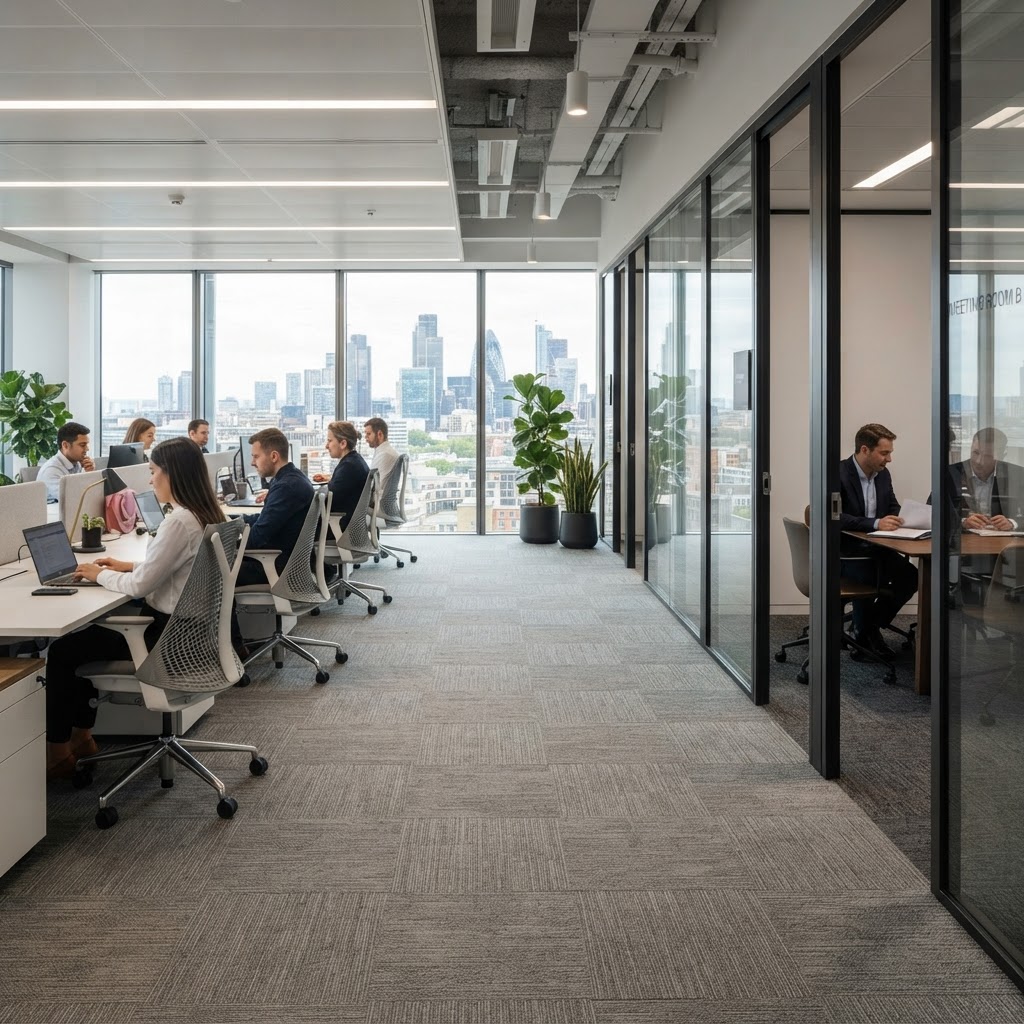
For commercial spaces — offices, medical facilities, retail, restaurants, and TI projects — glue down luxury vinyl is the clear recommendation. The dimensional stability, resistance to shifting under heavy traffic, and individual tile replaceability make it the only choice that will perform reliably for 10–20 years in a commercial environment.
PTAH Flooring has installed glue down vinyl in office renovations, medical offices, and retail spaces across Stuart, Port St. Lucie, Jupiter, and the Treasure Coast. Our Glue Down Luxury Vinyl Collection includes commercial-grade products with 20–28 mil wear layers backed by commercial warranties.
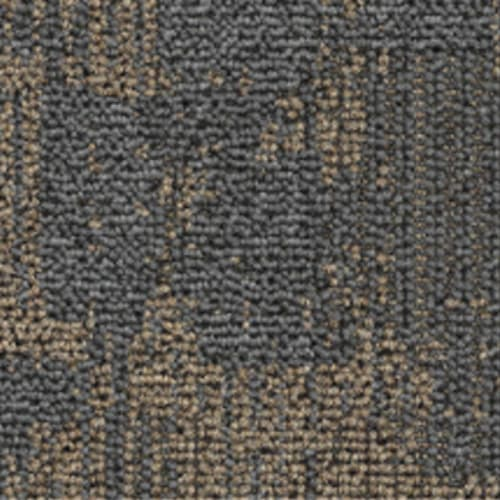
For mixed commercial spaces (e.g., an office with carpet tile in work areas and vinyl in corridors and break rooms), glue down vinyl pairs perfectly with commercial carpet tile. See our Commercial Carpet Tile Buying Guide for more on how these products work together.
Best Choice for Homes
For residential installations — living rooms, bedrooms, kitchens, bathrooms, and hallways — floating luxury vinyl plank is the preferred choice for most homes. It offers the same waterproof construction as glue down, with faster installation and lower cost. The click-lock system performs excellently in residential traffic.
Floating LVP is what PTAH Flooring installs in the majority of Treasure Coast homes. Explore our Luxury Vinyl Plank Collection and see our residential project showcase for real installation examples.
Exceptions where glue down makes sense in a home:
- Very large open spaces where plank stability is a concern
- Homes with heavy rolling traffic (wheelchairs, walkers)
- High-end installations where the premium feel of glue down is desired
- Stairs (glue down is the standard method for vinyl on stairs)
Pros & Cons
Glue Down Vinyl
Pros:
- Superior dimensional stability
- Will not shift, gap, or buckle
- Individual plank replacement is easy
- Commercial-grade durability
- Ideal for heavy traffic and rolling loads
- Thinner profile (good for transitions to other flooring)
Cons:
- Higher installation cost (adhesive, prep, labor)
- Requires very flat, smooth subfloor
- More difficult to remove if ever changing flooring
- Longer curing time before use
Floating Vinyl
Pros:
- Faster and less expensive installation
- More forgiving of subfloor imperfections
- No adhesive fumes during installation
- Can be walked on immediately after installation
- Easier to remove if ever replacing flooring
- Attached underlayment in many products
Cons:
- Less dimensionally stable under heavy traffic
- Click-lock joints can weaken over time in commercial use
- Plank replacement requires unlocking surrounding planks
- Slightly thicker profile (may affect transitions)
- Can feel slightly hollow underfoot without quality underlayment
Buying Checklist
- Wear layer: 20+ mil for commercial or busy homes; 12+ mil for light residential.
- Traffic assessment: Match the method to your traffic level — glue down for commercial, floating for most residential.
- Subfloor condition: Have PTAH Flooring assess your subfloor; glue down requires a very flat surface.
- Warranty: Verify the product carries a commercial warranty if used in a commercial space.
- Moisture testing: Essential for glue down over concrete.
- Transition planning: Consider transitions to adjacent flooring (carpet, tile, etc.).
- Stairs: Plan for glue down or stair nose molding on any stairs.
Our Recommendation
For commercial spaces: Glue down luxury vinyl. Period. The stability, durability, and repairability make it the only choice that will serve a business well for a decade or more.
For residential spaces: Floating luxury vinyl plank for most homes. It delivers the same waterproof performance at a lower installed cost, with faster installation. Choose glue down for stairs, very large open spaces, or if you simply prefer the premium feel of an adhered floor.
Explore our collections and get your project started:
- Glue Down Luxury Vinyl — commercial and high-traffic applications
- Luxury Vinyl Plank — residential floating installations
- Carpet Tile — pair with glue down for mixed commercial spaces
Ready for an estimate? Get your instant flooring quote or contact PTAH Flooring to schedule a consultation across Stuart, Port St. Lucie, Palm City, Jensen Beach, Fort Pierce, Jupiter, Palm Beach Gardens, and Vero Beach.