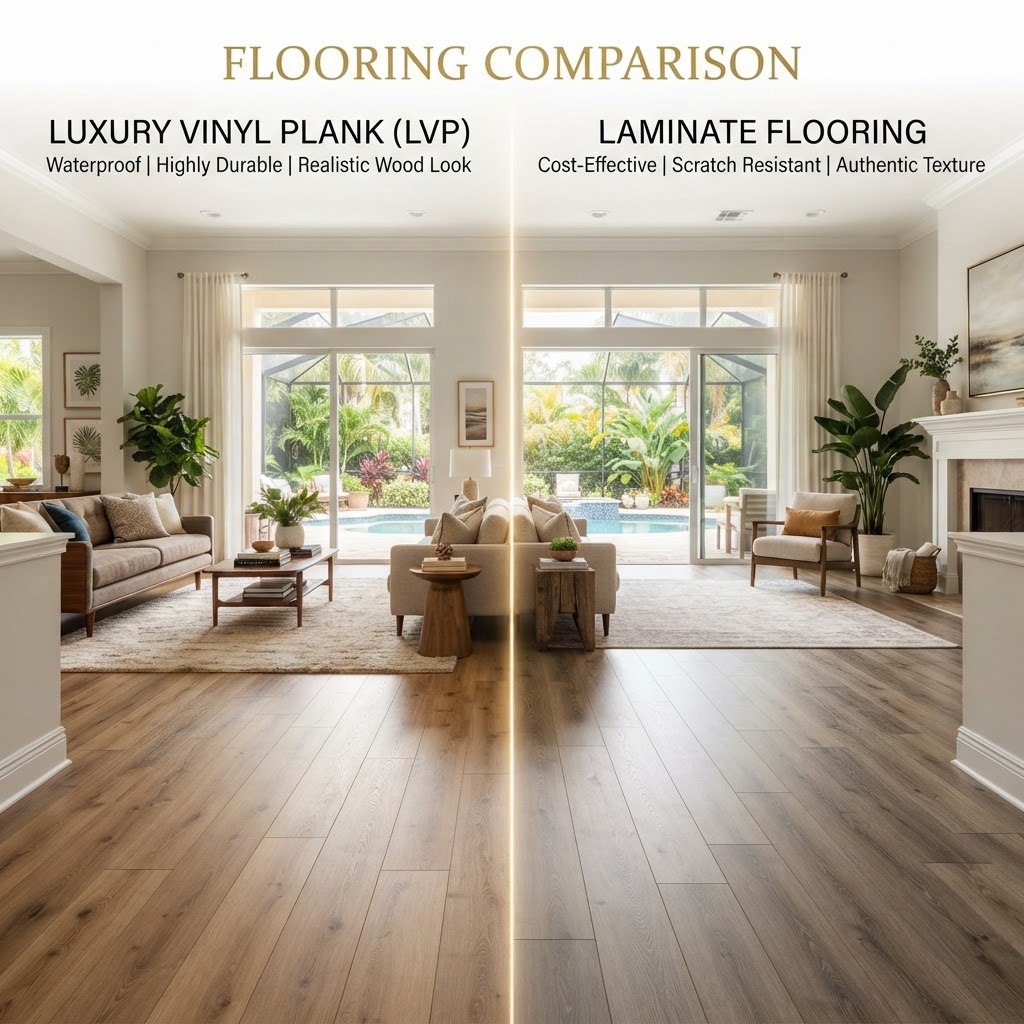
Quick Answer
For most Florida homes and businesses, luxury vinyl plank (LVP) is the better choice. It is fully waterproof, more scratch-resistant, easier to maintain, and better suited to the humidity of the Treasure Coast. Laminate remains a solid option for dry living spaces where a rigid, wood-like feel and budget are the top priorities.
Below we break down every factor that matters so you can make an informed decision for your specific space.
Expert Tip: In a humid climate like South Florida, water resistance should be a primary driver of your flooring decision — not an afterthought. The cost difference between LVP and laminate is small, but the long-term risk difference is significant.
What Is Luxury Vinyl Plank?
Luxury vinyl plank is a synthetic flooring product designed to mimic the look of natural hardwood. It is constructed in layers: a waterproof vinyl core, a high-resolution printed design layer that replicates wood grain or stone, and a protective wear layer on top that guards against scratches, stains, and fading.
Modern LVP comes in planks (to replicate hardwood) or tiles (to replicate ceramic or stone). The planks typically range from 4 to 9 inches wide and 36 to 60 inches long, with thicknesses between 4mm and 8mm. The wear layer — measured in mils (thousandths of an inch) — is the single most important spec to look at: a 12-mil wear layer is suitable for residential use, 20-mil is ideal for busy households and light commercial, and 28+ mil is built for heavy commercial traffic.
What makes LVP especially popular in Florida is its 100% waterproof construction. The vinyl core does not absorb water, swell, or warp when exposed to moisture, making it suitable for kitchens, bathrooms, laundry rooms, and areas with high humidity.
Explore our Luxury Vinyl Plank Collection to see the options PTAH Flooring installs across Stuart, Port St. Lucie, Palm City, and the surrounding Treasure Coast.
What Is Laminate?
Laminate flooring is also a multi-layer synthetic product, but its core is made from high-density fiberboard (HDF) — a compressed wood-based material. On top of the HDF core sits a photographic design layer (which can replicate wood, tile, or stone) and a clear protective wear layer. Beneath the core is a backing layer that provides stability and some moisture resistance.
Laminate was developed in the 1970s as an affordable alternative to hardwood and has improved significantly over the years. Premium laminates now feature embossed-in-register textures (where the surface texture matches the wood grain pattern), enhanced moisture-resistant cores, and tougher wear layers.
The key difference from LVP is the HDF core. While modern laminate is more water-resistant than older generations — some products carry water-resistance warranties of 24–72 hours — it is fundamentally a wood-based product. Prolonged water exposure can cause the core to swell, particularly at the joints, and once swollen, it does not return to its original shape.
Browse our Laminate Collection including the Arlington laminate line, which offers realistic wood visuals and enhanced moisture resistance.
Water Resistance
| Factor | Luxury Vinyl Plank | Laminate |
|---|---|---|
| Waterproof | Yes, 100% | Water-resistant (not fully waterproof) |
| Core material | Vinyl (non-absorbent) | HDF fiberboard (wood-based) |
| Water exposure limit | Unlimited | Typically 24–72 hours at joints |
| Swelling risk | None | Yes, at seams if exposed too long |
| Suitable for bathrooms | Yes | With caution; not ideal |
| Suitable for kitchens | Yes | Yes, with prompt spill cleanup |
Water resistance is where the two materials diverge most dramatically, and it is the single biggest reason LVP dominates the Florida market.
LVP's vinyl core is inherently waterproof. Water can sit on the surface indefinitely, and even if it seeps between planks, the material will not swell, warp, or degrade. This makes LVP suitable for every room in the house — bathrooms, kitchens, laundry rooms, mudrooms, and basements (though Florida basements are rare).
Laminate, by contrast, has an HDF core that is wood-based. While modern laminate products treat the edges and use water-resistant cores to delay absorption, standing water or prolonged moisture exposure will eventually penetrate the joints and cause swelling. Once the core swells, the damage is permanent and the affected planks must be replaced.
For Treasure Coast homeowners, where humidity is consistently high and afternoon thunderstorms are a fact of life, the waterproof advantage of LVP is a significant practical benefit.
Quick Fact: A flooded LVP floor can be dried, cleaned, and reinstalled in most cases. A flooded laminate floor generally requires full replacement of affected planks.
Scratch Resistance
| Factor | Luxury Vinyl Plank | Laminate |
|---|---|---|
| Wear layer | Vinyl (12–28+ mil) | Aluminum oxide coating |
| Scratch resistance | Very good | Excellent |
| Dent resistance | Good | Very good (rigid core) |
| Pet claw resistance | Good (with 20+ mil wear layer) | Very good |
Laminate has a slight edge in pure scratch resistance. Its top wear layer is typically made with aluminum oxide — one of the hardest materials used in flooring coatings — which makes it highly resistant to scratches from furniture, pet claws, and general abrasion.
LVP uses a vinyl wear layer, which is slightly softer than aluminum oxide. While a quality LVP with a 20-mil or thicker wear layer will resist everyday scratches well, it is marginally more susceptible to deep gouges from sharp objects or heavy furniture being dragged.
However, LVP compensates with better dent resistance in real-world use because it has a slightly more resilient surface that flexes rather than permanently denting. Laminate's rigid surface can chip or dent under heavy impact.
For homes with large dogs, either product performs well if you choose a quality tier. Look for LVP with at least a 20-mil wear layer and laminate with an AC4 or AC5 rating for residential high-traffic use.
Pet Performance
Florida homeowners frequently ask which floor is better for homes with dogs and cats. The answer involves more than just scratch resistance:
- Accidents: LVP wins decisively. Pet urine that sits on LVP can be cleaned without damaging the floor. On laminate, liquid can seep into joints and cause permanent swelling and odor absorption.
- Claws: Laminate has a slight edge in scratch resistance from large dogs, but a 20+ mil LVP performs adequately for most households.
- Comfort: LVP is slightly softer underfoot, which is more comfortable for older pets with joint issues. Laminate's rigid surface can be harder on aging animals.
- Slip resistance: Both can be slippery. Look for textured surfaces in either product. LVP with an embossed texture generally provides better traction.
Our recommendation for pet owners: Luxury vinyl plank, because the waterproof advantage far outweighs laminate's marginal scratch-resistance edge. A scratched plank can be replaced; a swollen, urine-damaged laminate floor often cannot.
Room-by-Room Recommendations
Bathrooms
Winner: Luxury Vinyl Plank
Bathrooms are the highest-moisture room in any home, and LVP is the clear choice. Its waterproof core handles splashes, humidity, and even a overflowing toilet without damage. Laminate in a bathroom is a risk — even water-resistant laminate carries joint-warranty limitations and is not recommended for full bathrooms by most manufacturers.
Bedrooms
Winner: Tie (slight edge to laminate for feel)
Bedrooms are low-moisture, low-traffic spaces. Both materials perform well. Laminate's rigid core gives it a more solid, wood-like feel underfoot, which some homeowners prefer in a bedroom. LVP is slightly softer and warmer, which can also be desirable. Either is a fine choice here.
Living Rooms
Winner: Tie
Living rooms see moderate traffic and occasional spills. Both LVP and laminate perform well. LVP gives you peace of mind against drink spills and pet accidents. Laminate offers slightly better scratch resistance and a harder, more authentic wood feel. Choose based on your household's biggest concern: moisture (pick LVP) or scratches (either works).
Kitchens
Winner: Luxury Vinyl Plank
Kitchens combine high traffic, frequent spills, and the risk of plumbing leaks. LVP's waterproof construction makes it the safer and more practical choice. A dropped glass, a spilled sauce, or a dishwasher leak that would damage laminate is no problem for LVP.
Rental Properties
Winner: Luxury Vinyl Plank (with a 20+ mil wear layer)
Rental properties need floors that survive tenant turnover, pet damage, and unpredictable maintenance. LVP's waterproof construction, replaceable planks, and durability make it the practical choice for landlords and property managers. Read our detailed guide on the Best Flooring for Rental Properties.
Expert Tip: For rentals, choose LVP with a minimum 20-mil wear layer and a click-lock installation system. Individual damaged planks can be lifted and replaced without disturbing the surrounding floor.
Cost Comparison
| Cost Factor | Luxury Vinyl Plank | Laminate |
|---|---|---|
| Material (budget tier) | $2–$4 / sq ft | $1.50–$3 / sq ft |
| Material (mid tier) | $4–$6 / sq ft | $3–$5 / sq ft |
| Material (premium tier) | $6–$9 / sq ft | $5–$8 / sq ft |
| Underlayment | Often attached | Often attached |
| Installation | Comparable | Comparable |
| Long-term replacement risk | Low | Moderate (water damage) |
Material costs between the two are comparable, with laminate typically running slightly less at the entry level. However, when you factor in the risk of water damage and replacement — particularly in a humid Florida climate — LVP often delivers better total cost of ownership over a 10–15 year period.
Get an accurate, itemized estimate for your specific project using our Instant Flooring Quote Calculator, or browse our flooring collections to compare product options.
Installation Differences
Both LVP and laminate can be installed as floating floors using a click-lock system, meaning the planks lock together and float over the subfloor without being glued or nailed down. This makes both products faster and less expensive to install than traditional hardwood or tile.
Key installation considerations:
- Subfloor preparation: Both require a clean, flat, dry subfloor. PTAH Flooring handles floor preparation — including grinding, patching, and moisture testing — as part of every installation.
- Underlayment: Many LVP and laminate products have an attached acoustic underlayment. If not, a separate underlayment is rolled out before installation.
- Expansion gaps: Both materials require a 1/4-inch expansion gap around the perimeter to allow for natural expansion and contraction. This is especially important in Florida's temperature and humidity swings.
- LVP can also be glued down: For commercial applications, glue-down LVP offers superior dimensional stability and easy plank replacement. See our Glue Down Luxury Vinyl Collection and our guide on Glue Down vs Floating Vinyl.
Maintenance
Both floors are low-maintenance, but there are important differences:
Luxury Vinyl Plank maintenance:
- Sweep or vacuum regularly with a hard-floor setting (no beater bar)
- Damp mop with a manufacturer-approved vinyl cleaner
- Avoid abrasive scrubbers, steam mops, and wax-based products
- Spills can be wiped up at any time without urgency
Laminate maintenance:
- Sweep or vacuum regularly (hard-floor setting only)
- Damp mop with minimal water — do not saturate
- Clean up spills immediately to prevent joint penetration
- Avoid steam mops entirely (heat and moisture can damage the core)
- Use furniture pads under heavy items to prevent scratches
The urgency of spill cleanup is the key difference. With LVP, a spill left overnight is a non-issue. With laminate, that same spill could cause permanent joint swelling.
Durability and Lifespan
| Factor | Luxury Vinyl Plank | Laminate |
|---|---|---|
| Expected residential lifespan | 15–25 years | 15–25 years |
| Commercial lifespan | 10–20 years (with 28+ mil wear layer) | 5–15 years |
| Fade resistance | Excellent (UV-stable wear layer) | Very good |
| Moisture damage risk | None | Moderate |
| Plank replaceability | Yes (especially click-lock and glue-down) | Yes (click-lock) |
Both products offer comparable lifespans when installed in appropriate environments. The wild card is moisture. A laminate floor that experiences even one significant water event may need partial or full replacement, while an LVP floor under identical conditions will be unaffected.
This is why PTAH Flooring, serving Stuart, Port St. Lucie, Jensen Beach, and the entire Treasure Coast, recommends luxury vinyl plank for the majority of Florida installations.
Pros & Cons
Luxury Vinyl Plank
Pros:
- 100% waterproof
- Excellent scratch and stain resistance (with quality wear layer)
- Softer and warmer underfoot than laminate or tile
- Realistic wood and stone visuals
- Can be installed in any room, including bathrooms
- Replaceable planks
- Excellent for Florida's humid climate
Cons:
- Slightly softer surface (more susceptible to deep gouges than laminate)
- Lower resale prestige than real hardwood
- Some budget products can dent under heavy furniture
- UV fading possible with prolonged direct sun exposure (quality products minimize this)
Laminate
Pros:
- Excellent scratch resistance (aluminum oxide wear layer)
- Hard, rigid, wood-like feel
- Typically lower material cost at entry level
- Wide range of realistic wood visuals
- Good for dry living spaces and bedrooms
Cons:
- Not fully waterproof — susceptible to joint swelling
- Not recommended for full bathrooms or laundry rooms
- Harder underfoot (less comfortable for standing and for pets)
- Cannot be refinished
- More vulnerable in Florida's humid climate
Buying Checklist
Use this checklist when shopping for either product:
- Wear layer: LVP should have at least 12 mil (residential) or 20+ mil (busy home/pets/light commercial). Laminate should be rated AC3 (residential) or AC4+ (high traffic).
- Thickness: 5mm+ for LVP, 8mm+ for laminate for better stability and feel.
- Waterproof warranty: Verify the warranty terms — especially for laminate, check the hours of water exposure covered.
- Attached underlayment: Check whether underlayment is included or needs to be purchased separately.
- Warranty length: Residential warranties of 15–30 years are standard for quality products.
- Texture: Embossed-in-register texture provides a more authentic wood feel.
- Plank dimensions: Longer and wider planks (7"+ wide, 48"+ long) look more like real hardwood.
- Installation method: Confirm click-lock floating vs. glue-down based on your space.
Who Should Choose Luxury Vinyl Plank?
Choose LVP if you:
- Live in a humid climate like the Treasure Coast
- Want flooring in kitchens, bathrooms, or laundry rooms
- Have pets (especially dogs prone to accidents)
- Prioritize water resistance and low maintenance
- Want a floor that can handle life's spills without panic
Who Should Choose Laminate?
Choose laminate if you:
- Are flooring dry living spaces (living rooms, bedrooms, hallways)
- Want the hardest, most scratch-resistant surface available in synthetic flooring
- Prefer a rigid, wood-like feel underfoot
- Are working with a tight budget at the entry level
- Do not have pets prone to indoor accidents
Our Recommendation
For the vast majority of Florida homeowners and businesses, PTAH Flooring recommends luxury vinyl plank. The waterproof advantage is simply too significant in our climate to ignore. The marginal scratch-resistance edge of laminate does not offset the risk of water damage — and water damage in laminate is usually permanent.
If you are flooring a single dry room (like a bedroom) and scratch resistance is your top priority, laminate is a reasonable choice. For everything else — especially whole-home installations, kitchens, bathrooms, and any commercial space — LVP is the smarter long-term investment.
Explore our collections to find the right product for your space:
Ready to get started? Get your instant flooring estimate or contact PTAH Flooring to schedule a free in-home consultation across Stuart, Port St. Lucie, Palm City, Jensen Beach, Fort Pierce, Jupiter, Palm Beach Gardens, and Vero Beach.